
The Role of Britain in the Abolition of Slavery
When Harriet Beecher Stowe visited the United Kingdom in 1853 following the publication and widespread success of Uncle Tom’s Cabin, she was ‘rushed by ecstatic crowds’ and warmly received. At this moment, slavery had been outlawed for 20 years in the UK, yet the USA was still thirteen long years and a major war away from introducing the thirteenth amendment following this path.¹ The UK and it’s Royal Navy are often credited with providing the impetus for the movement of emancipation internationally, although their actions to abolish slavery were only the culmination of decades of injustice, social evolution and suffering. This essay will seek to provide a comprehensive legal history of the fight for emancipation within Great Britain and its colonies, and, crucially, will evaluate the disparity between the official ending of the slave trade and proprietorship and the effective emancipation of the slaves.
In England and Scotland themselves, slavery was never made explicitly legal or illegal as such (a 1569 verdict, upheld in 1700 by the Lord Chief Justice John Holt, stated that English law could not uphold slavery as it had never been established officially), yet this ambiguity gave rise to the ability of wealthy landowners to exploit property law.² Generally, until the mid-19th century, slaves in Britain were viewed as chattel and property of slave owners. In 1781, for example, a ship carrying 441 slaves set sail from Accra in what is modern day Ghana, for Jamaica, having taken aboard twice as many Africans as it could safely carry. Its captain, captain Collingwood, had fallen ill on this journey. The subsequent breakdown of the structure of command precipitated a series of navigational errors that resulted in an extended voyage time. Aboard the ship, the supply of drinking water could not meet the demand of all slaves and crew members, and as such the crew resolved to throw overboard a total of 142 slaves, primarily women and children, to stretch the supplies further.³ ⁴ Upon landing in Jamaica, the crew demanded insurance coverage of £30 for each head of slaves, which were counted as ‘lost property’.⁵ The outcome of three subsequent court cases (Gregson v Gilbert (1783) 3 Doug. KB 232) held that in some circumstances, the murder of enslaved Africans was legal and that insurers could be required to pay for those who had died.⁶ Thus, slaves were not viewed as being party to any social contract based on mutual defence of liberties, as laid out by Thomas Hobbes and John Locke, and were not persons to whom full protections under the law could were afforded. Rather, as explained above, their legal status was parallel to that of property. This status was ostensibly incompatible with certain precepts of the British constitution, such as Clause 39 of the 1215 Magna Carta, which served to protect all ‘free men’ in the England and Scotland from unjust imprisonment, and afforded all the right to a free trial.⁷ Yet Africans were considered foreign and could by no formal process of naturalisation be incorporated as citizens anywhere in the British mainland.⁸
This apparent inconsistency in British law was challenged numerous times in courts across both England and Scotland. In Scotland, once in 1755, and again in 1768, cases were brought by black men, baptised in Scotland, to contest the legality of slavery (Montgomery v. Sheddan (1755) and Spens v. Dalrymple), although in both cases deaths of the plaintiff and the defendant, respectively, brought an end to the suits before the verdict could be reached.⁹ The case that set the precedent for affording rights (albeit limited) to slaves in England and Scotland (not the Caribbean) was that of the fugitive slave James Somersett, who had been recaptured by his slave owner and forcibly loaded onto a ship bound for Jamaica. Three godparents of his issued a writ of habeas corpus; the case was brought before the Chief Justice of the Court of the King’s Bench, Lord Mansfield, a judge who himself harboured an abolitionist sentiment. After a month of deliberation and consultation with no less than twelve colleagues, on 22 July 1772, Mansfield ruled:
‘It [slavery] is so odious, that nothing can be suffered to support it, but positive law. Whatever inconveniences, therefore, may follow from a decision, I cannot say this case is allowed or approved by the law of England; and therefore the black must be discharged’.¹⁰
Although the verdict was crafted such as only to prohibit the transport of slaves outside of Great Britain itself, the case set a precedent for the endowment of slaves with certain liberties and upheld a notion that slavery was, in essence, an arbitrary product of ‘positive law’.¹¹ At the time the verdict was interpreted to have stated that slavery was illegal under English common law, leading to a mass emancipation of 10,000 to 15,000 slaves in the following three years, despite the large financial burden that this process entailed.¹² In 1778, Knight v. Wedderburn, a similar case in Scotland resulted in the Scottish Court of Session ruling that chattel slavery was not legal under Scottish law, although certain hereditary slaves were kept until 1799 when a Parliamentary emancipatory act towards colliers and salters was passed. Mansfield himself, defending his verdict, proclaimed, ‘fiat justitia, ruat cælum, let justice be done whatever be the consequence’.¹³
However, overseas and across the empire slavery was still buttressed by legal justification. The West Indies were economically reliant upon the slave trade, and continued to receive huge numbers of Africans, necessitated by a prosperous sugar trade and a high slave mortality rate, both in transit and in the colonies themselves (in Jamaica, about 35.1 slaves per 1,000 died).¹⁴ Between 1606 and 1807, an estimated 2.3 million slaves arrived in the British West Indies to work sugar plantations, with up to 40,000 Africans being transported per annum.¹⁵ This was increasingly recognised in the British public eye; by the 1790’s, major movements, which had previously simmered primarily amongst Quaker communities, towards emancipation penetrated British society, spearheaded by politician William Wilberforce.¹⁶ In May 1787, the Society for Effecting the Abolition of the Slave Trade was established. Of their twelve founding members, nine were Quakers.¹⁷ Founded at a time in which three quarters of the globe lived under some form of enslavement, serfdom, debt bondage or indentured servitude, the social reverberations created, over the course of a few years, by this society touched the lives of millions.¹⁸ Most people implicitly supported and accepted slavery in the West Indies; the society, through pamphlets, petitions and public speaking, provided the impetus for a social pivoting against ubiquitous colonial exploitation.¹⁹ They were responsible in 1788 for the publication of one of the first books on the subject of the plight of the enslaved subjects in the Caribbean, entitled the Essay on the Impolicy of the African Slave Trade, and brought hundreds of petitions to Parliament.²⁰ French political philosopher Alex de Tocqueville documented the fact that this movement was “absolutely without precedent...If you pore over the histories of all peoples, I doubt that you will find anything more extraordinary”.²¹
In this moment of expedited social metamorphosis, two major geopolitical events laid pressure on the British to act towards the goal of abolition of slavery on its colonial territories: the Danish abolition of the slave trade in March 1792 and the Haitian revolt and revolution against the French between 1791 and 1804. Marked by a transition away from sugar industry and a swing in British interests towards the Indian subcontinent, the UK in 1807 outlawed the slave trade and in 1833 slavery itself.²²
In 1789, Haiti – then Saint Dominique – had a total population of around 500,000 slaves and 32,000 white people. The slave system in the French colonies had long been regulated by a series of royal edicts, of which the most prominent had been promulgated in 1685 by Louis XIV, which constituted the ‘code noir’. This code prescribed a harsh regime of punishment for slave escapees and those who defied the rule of their slave masters. This was not unlike the practise of slave punishment that the British Empire engaged in.²³ In 1791, a slave revolt was sparked on the island, continuing until 1793 when post-revolutionary France outlawed slavery, and reignited once again in 1802 after the Napoleonic reinstitution of the practise. Finally, in 1804, Haiti was declared an independent state governed by freed slaves.²⁴ This revolution created a real notion of economic and geopolitical threat. British colonies, in which the black subjugated population far outnumbered the white settlers, were precariously placed near the epicentre of revolutionary sentiment in Haiti. At a time in which Europe was plagued by the conquests of Napoleon and the resultant wars of the third and fourth coalitions, and against the backdrop of colossal French victories, most notably at Austerlitz in 1805, Britain could hardly afford to defend its economic interests in the Caribbean against this sentiment.²⁵
In 1791, William Wilberforce failed to push a bill on the abolition of the slave trade in the British Empire through the House of Commons.²⁶ In the subsequent year, Christian VII of Denmark–Norway decreed its abolition in his Kingdom.²⁷ According to professor of political science Christoffer Chris-Pedersen, it was Wilberforce’s failure to pass a socially progressive bill in the UK that prompted this step by the Dutch, made in order to gain international prestige.²⁸ Little comparison, however, can be drawn between the Danish slave trade and sugar industry and that of the much larger, more profitable overseas holdings of the British Empire. Denmark’s sugar business, furthermore, was largely not built upon domestic slave trade networks. Referring to a ‘mercantilism manqué’, historian Neville Hall explains that the principal Danish sugar colony, St. Croix, largely depended on the British slave trade for supplies, and that the Danish slave trade generally was ‘based upon extensive co-operation with other slave trading nations both in Africa and the West Indies’.²⁹ Jens Vibæk, a Danish historian, argued many Danes at the time believed that slaves in the colonies themselves, especially given better treatment, would reproduce at replacement levels and render the need for a slave trade obsolete. Denmark’s slave trade business was embryonic, yet exerted social influence upon the British and their government to mirror these actions. This pressure was amplified by the French abolition of both slave trade and possession between 1793 and 1802.
Largely as a response to this in 1796, the House of Commons approved a law that would ‘gradually’ (the original bill proposed by William Wilberforce, which excluded this key term, was struck down) outlaw the slave trade itself.³⁰ The House of Lords, the second chamber of the UK’s legislative government, deferred the motion to a later date – this motion would never be debated. The matter was resurrected in 1807; Lord Grenville, during his short tenure as British Prime Minister, led an effort to pass an act that would outlaw the trade in slaves whilst his Foreign Secretary, Lord Howick, spearheaded the promulgation of the same cause in Parliament. Aided by the majority-abolitionist hundred new Irish Members of Parliament which joined the legislative chamber under the 1800 Acts of Union, the bill passed through the Commons after a ten-hour debate on the 23 February 1807 by an overwhelming 283 votes to 16 and subsequently through the House of Lords. After approval by King George III, it was signed into law. However, this bill only limited the trade in slaves; no such prohibition was placed upon their ownership and exploitation. That is, slaves could no longer be transported from Africa to the Caribbean, yet their ownership in the Caribbean itself remained unrestricted.³¹
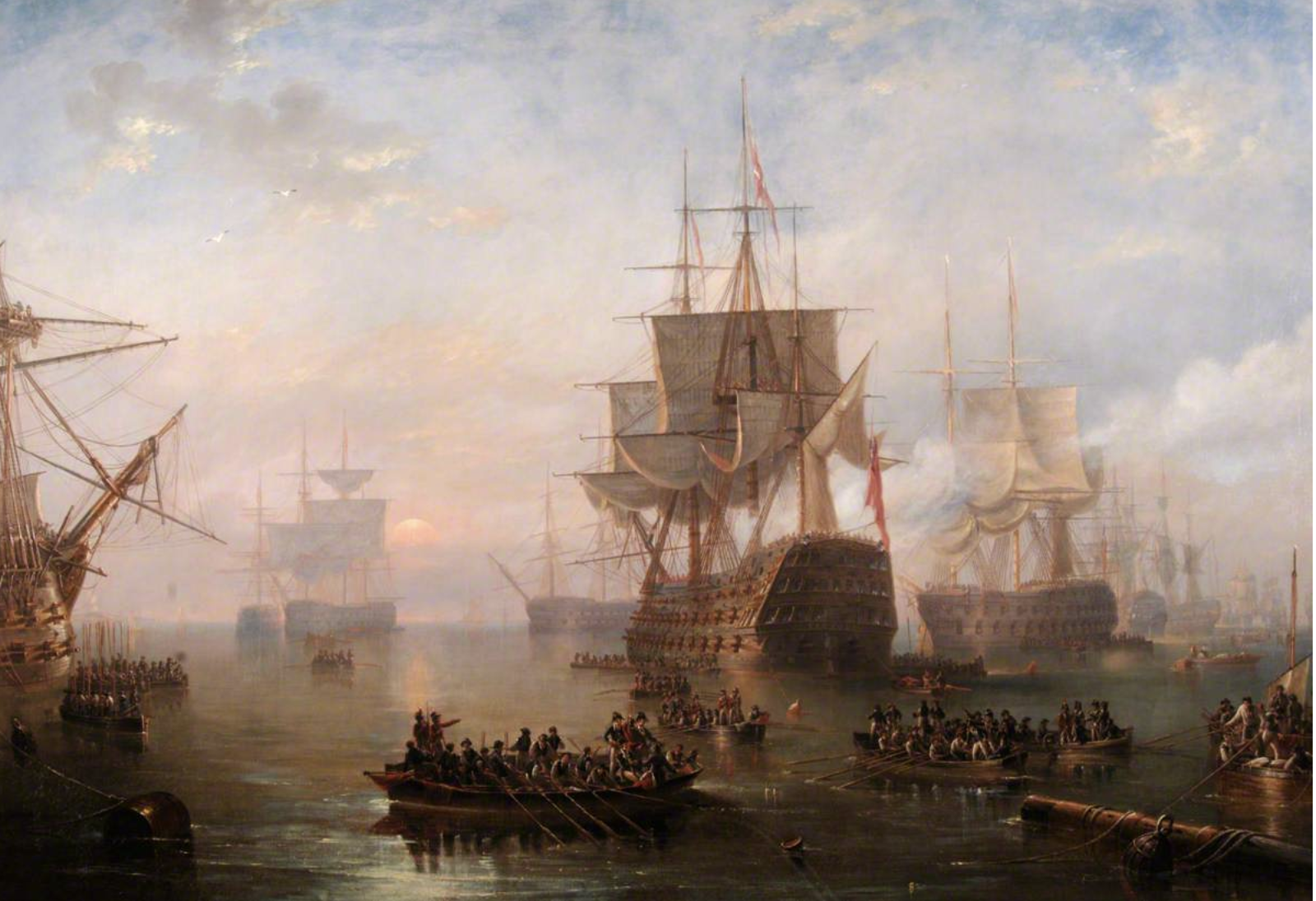
This major legislative move required enforcement; the British Navy created the West Africa Squadron that would continuously patrol and prevent the export and trade of slaves to the West Indies.³² By 1818, this squadron had six ships, growing further to 25 by the mid-19th century. Between 1808 and 1860, approximately 1,600 slave ships were detained, and 150,000 Africans were released back onto the continent.³³ ³⁴ Although fairly costly, both in its reallocation of a large share of naval resources and in respect to over one and a half sailors who succumbed to disease during patrols, it only succeeded in detaining about ten percent of all slave ships. The greatest effect that this West Africa squadron had was in setting a precedent for extending the restriction of the slave trade unto other nations. In 1807, this squadron only had the right to seize British ships. In 1810, under great diplomatic pressure (owing to the ongoing war in Spain against the French), a convention was signed with Portugal that extended the mandate of the British Navy to Portuguese slave ships. Similar acts were signed to broaden the British right to police colonial slave trade with France in 1815, following the defeat and exile of Napoleon, with Spanish slave ships travelling above the equator in 1818 and below the equator in 1820, and with Brazil in 1826. A clause in the 1815 Congress of Vienna saw all signatories pledge to gradually abolish the slave trade.³⁵ British vessels detained by the West Indian Squadron were taken to and tried in vice admiralty courts (originally the punishment would be a fine of £100 per slave, although in 1811 slave trade became a felony offence by law) and those of other nations were tried in Mixed Commission courts. These courts would have international representation, although often their function was bulwarked by a reluctance in cooperation between these states.³⁶ Nevertheless, the abolition of the slave trade in the British Empire created a precedent for the limiting of the industry of slavery both in the UK itself and across other states and governments, particularly in Europe.
Even as the movement for outlawing the slave trade gained momentum, the underlying problem of the exploitation and inhuman treatment of slaves continued unabated. Paradoxically, however, and lending credence towards economic rather than moral historical interpretations of the move towards emancipation, there was little political discussion and interest in the abolition of slavery itself. The first prime minister of Trinidad and Tobago, Eric Williams, stated in his book Capitalism and Slavery that the lull in anti-abolitionist sentiment between 1807 and 1823 came as a result of the realisation that industries built on the back of slavery in the Caribbean generated far more profit than the slave trade ever had, and hence there was a greater economic necessity for preserving this practise.³⁷ Williams argues that the subsequent decline in the profitability of slavery came as a result of the Industrial Revolution and sharply increased after 1823, serving to provide an economic justification for the abolition of slavery itself. There was no longer a need to protect the economic interests of slave owners and Caribbean plantations.
It was precisely in 1823 that the Anti-Slavery society was founded in the United Kingdom.³⁸ Although this society was characterised initially by a wide range in views, with more conservative (older, generally) members advocating a gradualist approach to abolitionism and younger members, who regarded slavery as a mortal and intolerable sin, advocating cessation of all activities involving the practise forthwith.³⁹ The latter position, fortunately, saw greater success and a more active campaign, with publications such as Elizabeth Heyrick’s 1824 pamphlet Immediate, not Gradual, Abolition garnering support amongst the British populace.⁴⁰ Joseph Sturge and other believers in the cause of immediate abolition publicly campaigned throughout Britain to engender public pressure upon the government to enact reform. Auxiliary societies, including those set up by women, worked to create sympathy for slaves. The West Bromwich Ladies Society for the Relief of Negro Slaves, for instance, worked to support the first slave narrative to be published by a black woman, Mary Prince, The History of Mary Prince, A West Indian Slave (1831).⁴¹
In 1831 and 1832, two major events catalysed the abolition of slavery in the UK. The first of these was the Baptist war of 1831–1832, a large-scale revolt against slavery and British rule by Jamaican slaves. It happened over the course of eleven days, after which plantation owners and the local British garrison were able to violently suppress the uprising, killing approximately 500 people and subsequently executing over 300. Nevertheless, British estimates in 1832 put the total cost of property destroyed £1,154,589 (roughly £124,000,000 in 2021). Thousands of rebels had set fire to more than 100 properties, destroying over 40 sugar works and the houses of nearly 100 slavers.⁴² ⁴³ Two broad inquiries were launched on account of the loss of life and property, and the brutal suppression of the revolt caused outrage in parliament and amongst the British public, as well as having an economically sobering effect upon British industry in the Caribbean and its perception. The second major event that contributed to the move to abolish slavery in 1833 was the Reform Act of 1832. Prior to this act, many boroughs and constituencies in Great Britain, which was ostensibly governed by a democratic body, contained little to no inhabitants. These came to be known as ‘rotten boroughs’, and the small populations and private property within them could be bribed and bought; rich plantation owners could effectively buy seats in Parliament, which would be leveraged to bulwark reform against the institution of slavery. The Reform Act of 1832 swept away their rotten borough seats, clearing the way for a majority of members of the House of Commons to push through a law to abolish slavery itself throughout the British Empire.⁴⁴
In 1833, Earl Grey’s reforming administration passed the Slavery Abolition Act. This, although ostensibly emancipating all chattel slaves, effectively adopted a gradualistic approach to slave emancipation. All slaves under the age of 6 were freed immediately, although those above this age became party to ‘apprenticeships’ which effectively constituted a continuation of slavery, until in 1838 and 1840 British parliamentary agitators successfully campaigned for its termination in two successive acts.⁴⁵ However, even so the conceptions of freedom between slaves and slave owners differed fundamentally; the latter saw the future of emancipated slaves still tied up on large plantations, although slaves themselves preferred to acquire and work independent plots of land.⁴⁶ In areas where the land/labour ratio favoured the British plantation owners, such as Barbados, attaining true independence from their land was exceedingly difficult. In areas, such as Jamaica, where land was abundant, many plantation owners went into financial ruin.⁴⁷ When, through systems of ‘apprenticeships’, the plantation owners could no longer force emancipated individuals down an economically productive and advantageous route, they resorted to using other measures. At a local level, ‘planters tried to force payment or rent for houses and provision grounds that slaves had occupied as de facto proprietors’.⁴⁸ At various colonial legislatures, planters would seek to utilise tax, land and vagrancy laws to discipline former slaves in various ways.⁴⁹ Ultimately, however, the effective ending of coercive and exploitative labour practices throughout the empire and in the West Indies outlasted the official abolition of slavery. The British Parliament tentatively offered assent to ‘indentured migration’ from countries such as China and India, whereby workers served 5-year terms on large plantations in environments in which their owners held much control over their lives and broad rights to punish them. Between 1838 and 1865, 96,581 Indians were introduced into the West Indies, although the practice was widespread all across the empire, in places such as India itself and Sri Lanka and continued into the 1860’s.⁵⁰
The British abolition of slavery, thus, was less a product of the benevolence and moral clarity of the British themselves, and the exploitation of labour effectively far outlived he emancipation of slaves in its empire. In fact, by the 1850’s, theories of Social Darwinism had led race to emerge as a key explanatory category for the failure of maintaining large exploitative plantations and factories in the West Indies, ensuring that the ‘failures’ of abolition were traced to the innate inferiority of the Negro race.⁵¹ Hence, although Britain did have an influential role in the abolition of the abusive and immoral practice of slavery, the strategy pursued by them was not driven by straightforwardly virtuous motives.
Footnotes
Historic Hansard.
Mtubani (1981), pp. 71–75.
Lewis (2007), p. 363.
Rupprecht (2008), p. 268.
Weisbord (1969), p. 562.
Krikler (2007), p. 38.
The Magna Carta Project.
Historical background information on nationality.
“Slavery, freedom or perpetual servitude?”.
Moncreiff (2006), pp. 85–86.
Moncreiff (2006), pp. 85–86.
Murrin (2013), p. 119.
“Easter Term”, 1772.
Kiple (1985), p. 173.
“Estimated Number of Slaves Who Arrived from Africa in the British Caribbean” (2020).
Hague (2008), p. 327.
“The Tools of the Abolitionists” (2023).
Hochschild (2011).
“The Abolition Movement”.
“Foundation of the Society for Effecting the Abolition of the Slave Trade”.
Hochschild, Los Angeles Times (2005).
“The Abolition Movement”.
“Slavery and the Haitian Revolution”.
Findlay (2017), p. 258.
Schroeder (1994), pp. 305–310.
Pollock (1997), pp. 105–108.
Røge (2014), pp. 576–592.
Vibæk (1976), p. 86.
Hall (1994).
Hochschild (2005), p. 252.
“Slave Trade Abolition Bill” (1807).
Lewis-Jones, The Royal Navy and the Battle to End Slavery (2011).
Lewis-Jones, The Royal Navy and the Battle to End Slavery (2011).
“Chasing Freedom Information Sheet”.
Bethell (1966), p. 79.
Shaikh, p. 44.
Williams (1964), pp. 67–69.
“Anti-Slavery Society”.
“Society for the Mitigation and Gradual Abolition of Slavery throughout the British Empire”.
“Anti-Slavery Society”.
“Anti-Slavery Society”.
Reckord (1968), pp. 122, 124–125.
Dunn, pp. 343–344.
“Reform Act 1832”.
John (1992), pp. 371–379.
Holt, pp. 151–153.
Green, pp. 191–228.
Holt, p. 154.
Drescher, pp. 158–159.
Northrup (1995), pp. 87–103.
Bolt (1971), pp. 75–108.