
The Art of the Deal: Decoding Donald Trump’s Negotiation Strategy
‘Deals are my art form. Other people paint beautifully or write poetry. I like making deals, preferably big deals. That’s how I get my kicks.’1
For Donald Trump, every deal takes the form of a distributive bargain. There is always a winner and a loser. This view of negotiation - which he lays out unambiguously in the Art of the Deal - was built in the world of New York real estate, where Trump was constantly at odds with rival contractors, regulators, and politicians, and has brought a seismic shift to the post-war geopolitical status quo.
The tension between Trump’s style and voluntary global trade networks arises from a fundamental incongruity of worldviews; historically, most trade has been driven by the possibility of mutual gain. In fact, mutual gain is the reason for engaging in trade.2 His use of blunt, 19th century instruments of economic disruption has led to the fraying of relations with historic allies precisely because it constitutes a rejection of the view that collective prosperity could be reached through collaboration.3 If in his first term the president was reluctant to disrupt mature international relationships, the gloves are off in the era of Trump 2.0.
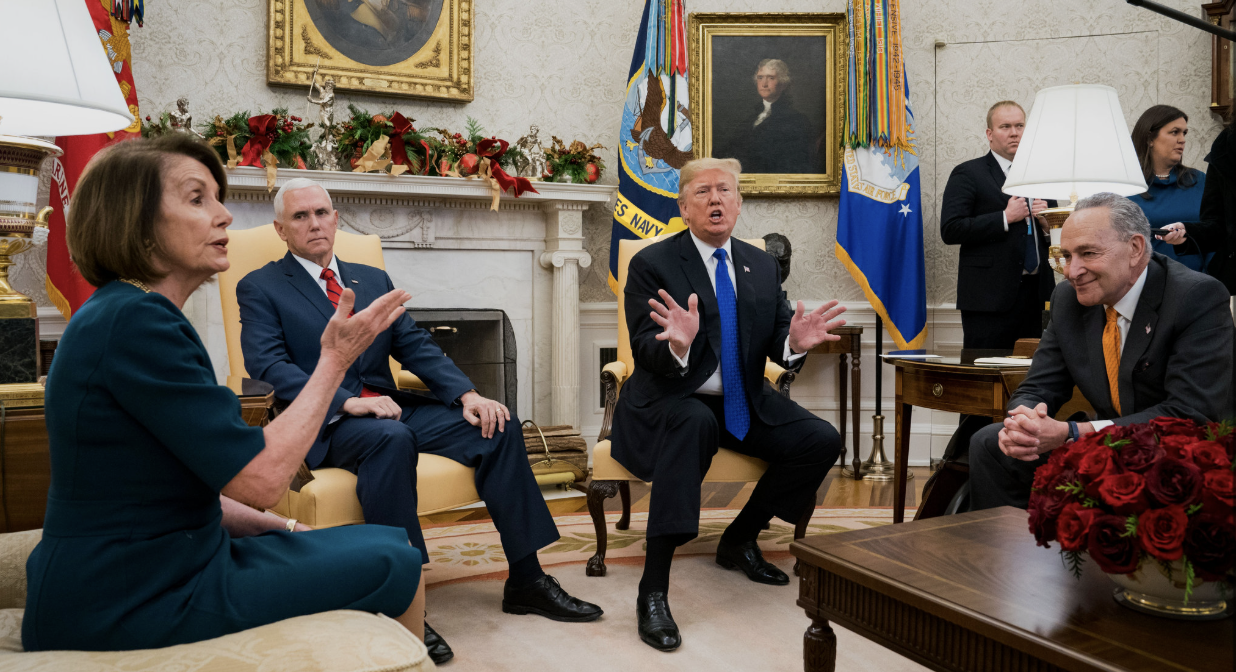
At first glance, wild volatility in dealing with both adversaries and allies has shown nothing to be predictable but unpredictability itself. His social media outbursts, tariff threats, and frequent televised explosions (most notably in his meeting with Ukrainian President Zelenskyy in the Oval Office) have appeared irrational to many observers, and can hardly be explained by traditional theories of diplomacy.4
Fortunately, Trump’s sixty-year-long record of deal making, the lessons from which he collates in a number of business memoirs (most notably the ‘Art of the Deal’), gives a good framework for understanding his distinctive modus operandi.
This article will analyse the strengths and strategy of Trump’s deal making style, relying heavily on his own words. It concludes by summarising 16 key lessons from his approach.
Trump’s behaviour patterns
Donald Trump exhibits four discernible overarching behaviour patterns5:
Observer: He enters into negotiations with assessments of his counterparts’ strengths, needs, and vulnerabilities.
Performer: Perennially aware of media attention, he plays to the audience to maximise his negotiating leverage.
Controller: A preference for tight, top-down leadership style makes him efficient and nimble in negotiation.
Disruptor: He gains leverage through unpredictability, and - gut-driven, action-oriented and risk-tolerant - draws strength from adversity.
Below are each of these four aspects, examined more closely:
Observer.
Speaking on a talk show in 2009, Trump emphatically told the audience that ‘being able to size up your opponent’ is a crucial first step to take before any negotiation. Interlocutors, he continues, must always be adversaries: ‘when they are on the other side of of the table - they are an opponent.’6 It is clear from this framing that Trump seeks to maximise his own winnings at the expense of others, in what he views as an adversarial environment. Shark Tank investor Barbara Corcoran notes his mastery in ‘picking out the vulnerability in someone’s personality’. ‘He can smell it, sense it, and trust it.’7
Crucially, ‘sizing up’ opponents must involve empathising with their situation: ‘you’ve got to know what the other side wants and where they are coming from’.6 Although this may seem obvious, he emphasises that ‘frequently, people are so involved in trying to get what they want that they ignore other people’s needs and objectives and don’t successfully connect’.7
Yet Trump is distinctly more forceful in his insistence on knowing one’s opponent’s ambitions and vulnerabilities, especially when they run beyond or are different to their publicly-stated positions. When observing an opponent, he scrutinises them exhaustively: ‘find out who your adversaries are, what resources they have, who is backing them, how much they want, why they want it, how much they will settle for, and how much they will pay or insist on receiving.’8
Far from being an impulsive, irrational attack dog, Trump only picks fights when he believes he can win them.
Performer
Trump has been famous for longer than the average American has been alive. He lives and breathes fame, and is acutely attuned as to how the public perceives him. ‘Life is a performance art,’ he wrote in Think Like A Champion. ‘Understand that as a performer, you have a responsibility to your audience to perform to the best of your ability.’9 His distinctive remodelling of the Oval Office, ambitious architectural projects across Washington DC, and remarkable physical appearance, all read as signs of someone obsessed with his public image. If previously he was focused on curating an image of a deal making virtuoso, since the 2024 election he has pivoted somewhat towards a more grandiose vision of himself as a quasi-imperial statesman. But his most defining feature has remained constant throughout: Trump is a winner.
The president pushes common negotiation techniques to their limits to project dominance over his opponents. For instance, an openness to alternatives and an understanding of when to ‘walk away’ is an orthodox component to any negotiation. Trump takes this to its extreme, advising those around him to feign disinterest and gauge the level of insistence exhibited by the counterparty: ‘to speed up negotiations, be indifferent. That way you’ll find out if the other side is eager to proceed’.10 If the other side seems too eager, Trump can smell blood in the water. He recognises the need to follow through on threats to walk away to maintain credibility, even if there are cards on the line. In the Art of the Deal, he recounts making such a move in negotiations with the New Jersey licensing commission for a casino licence. ‘As much as I wanted to build a great casino on the site I’d assembled, I said, I had a very successful real estate business in New York and I was more than willing to walk away from Atlantic City if the regulatory process proved too difficult or too time-consuming.’11
In negotiations, Trump anchors high and opens with a maximalist demand. ‘My style of deal-making is quite simple and straightforward. I aim very high, and then I just keep pushing and pushing and pushing to get what I'm after. Sometimes I settle for less than I sought, but in most cases I still end up with what I want’.12 His use of tariff threats to demand absurd concessions as president fits within this characterisation, although Trump rarely gets - despite his claim to the contrary - his original demands met in full.
"I went in and asked for the world - for an unprecedented tax abatement - on the assumption that even if I got cut back, the break might still be sufficient," Trump wrote of one of his deals with regulators in New York City.13
Controller
Scott Bessent, in recent remarks on Trump’s stamina, noted that the president had called him a few days ago at 1:52 in the morning. His announcement of sweeping 25% tariffs on the EU over Greenland was made at 1:36 AM, less than a week prior to Bessent’s comments. Could it be that he only informed his Treasury secretary of this move after the fact? This wouldn’t be hard to imagine, especially considering the fact that prior to the so-called ‘Liberation Day’ announcement on April 5th, 2025, even prominent officials and those closest to the president were not privy to his forthcoming tariff plans.
This would be reflective of Donald Trump’s clear preference for efficiency and centralisation of control in the organisations that he runs. He sees a lean command structure as a key prerequisite for effective management: ‘We [the Trump Organisation] had one major advantage: the fact that we are not a bureaucracy. In most large public corporations, getting an answer to a question requires going through seven layers of executives, most of whom are superfluous in the first place. In our organisation, anyone with a question could bring it directly to me and get an answer immediately. That's precisely why l've been able to act so much faster than my competitors on so many deals’.14 This is not to say that he does not seek input or advice from hose that surround him. But, by disposition presidential, he moves fast and prefers that his vote be the only one that ultimately counts.
He emphasises that a system with a single supreme decision maker at its helm demands their ‘total focus’. He elaborates: ‘I think of it almost as a controlled neurosis, which is a quality l've noticed in many highly successful entrepreneurs. They're obsessive, they're driven, they're single-minded and sometimes they're almost maniacal, but it's all channeled into their work’.15
This is why he demands loyalty and deference from those within his administration. He needs to be able to rely upon his subordinates to execute his commands with haste. A terse summarisation of this management philosophy is offered in the Art of the Deal. ‘Leadership is not a group effort. If you’re in charge, then be in charge.’16
Disruptor
‘If you're going to achieve anything, you have to take action’.17
Trump prioritises his intuitive impulses, often favouring them over more conventional or evidence-based strategies. ‘Listen to your gut, no matter how good something sounds on paper’, he advises in Art of the Deal. He repeated this advice ten years later. ‘The chosen few,’ he wrote, ‘can just go with their gut’.18
Trump’s notoriously pugnacious character is integral to his role of ‘disruptor’. ‘That's just my makeup,’ he explains in The Art of the Deal. ‘I fight when I feel I'm getting screwed’. He puts it even more broadly in a 2018 interview, bluntly admitting, ‘I love fighting ... battles’.19 This fighting style is clearly present in his attacks on domestic opponents and decisive military actions against foreign adversaries. It is this readiness to fight that underpins his doctrine of ‘peace through strength’. Despite this, he notes in Trump 101 that ‘anticipating and preparing for problems will save you time and resources and stop surprises that could cost you a ton.’20
Most importantly, Trump the disruptor wields ambiguity to his advantage by attempting to keep an informational edge over his opponents. This is most evident in his unpredictable conduct of foreign and tariff policy. For him, creating a disparity of knowledge involves two components: his aforementioned preference for exhaustive preparation to prevent being caught off guard, and a habit of keeping his own cards close to his chest.
Five years before his first presidential run, he wrote, ‘never let anyone know exactly where you're coming from. Knowledge is power, so keep as much of it to yourself as possible’.21 He then re-affirmed this in a 2016 campaign rally, plainly explaining, ‘I want to be unpredictable.’ Slamming Hillary Clinton’s publicly accessible roadmap to fight ISIS, he continues: ‘we must as a nation be more unpredictable’. He continued to harangue Hillary over this point in the presidential debate, loudly criticising the plan as ‘telling the enemy exactly what you want to do’. The president vaunts his ability to deter dictators by leveraging ambiguity.22 The war in Ukraine, he claims frequently, ‘would have never started’ if he had won his campaign for re-election in 2020, and his recent history of ordering military strikes has indeed struck fear into the Ayatollahs.
A part of this strategy is a refusal to temper threats and discount options when negotiating. ‘You don't want to say 'take everything off the table' because you're a bad negotiator if you say that. ... Look, nuclear should be off the table, but would there be a time when it could be used? Possibly. ... I would never take any of my cards off the table’.23 Donald Trump is willing to threaten anything and everything at his disposal to get what he wants. Under his leadership, unpredictability, for better or for worse, is the new normal.24
Trump’s negotiation approach
Trump uses each of these pattern behaviours systematically.
In short:
As an observer, he seeks to pick out opponents with few options available to them, giving him both immediate leverage (as the controller) and an ability to flaunt his own magnanimity - in contrast to their desperation or weakness - when engaging in a deal. If this is not possible immediately and his counterparts refuse to cede ground, Trump moves (as a performer) to denigrate their alternatives to negotiation. He thereby produces a structured choice between his favoured deal, which he promotes with his Trumpian bravado, and other, less favourable options. When an adversary considers the the latter, they are forced to consider a characteristically unpredictable response. If other parties accept his offer, he often views them as being in his debt. Trump the disruptor can then leverage this ‘debt’ to force outsized concessions in subsequent deals and prompt threats of disproportionate retribution if counterparts do not reciprocate.
The following part details his approach in more detail:
Choose counterparts with no options
At a business expo, Trump reportedly told the audience that ‘I love losers because they make me feel so good’.25 Negotiating with ‘losers’ affords him maximum leverage, which is of critical importance in negotiations - ‘don’t make deals without it’.26 Trump uses his role of ‘Observer’ to seek out vulnerable counterparts - a crucial first step to a successful negotiation. For instance, when recalling his push to acquire a location in which to build the Commodore Hotel, he explains that he leveraged ‘the depressed state of New York and the country in general … to get what I wanted - the best deal possible’.
He wields this leverage most effectively in bilateral negotiations, openly favouring them to to multilateral ones. They are easier for him to control, as he has the space to prod at his opponent to identify and exploit key weaknesses. Recalling his push to acquire a location in which to build the Commodore Hotel, he explains that he leveraged ‘the depressed state of New York and the country in general … to get what I wanted - the best deal possible’.
2. Denigrate the opponent’s next-best alternative
In order to make his counterparts sense that Trump’s proposed deal works best for them, Trump tries to belittle their alternatives. After Canada’s recent announcement of tighter trade links with China, the president insisted that supplanting the United States as a principal partner and ally would play out badly for its northern neighbour: ‘China will eat Canada alive, completely devour it, including the destruction of their businesses, social fabric, and general way of life.’
‘I am very competitive and I’ll do anything within legal bounds to win. Sometimes, part of making a deal is denigrating your competition’.27 When Trump decided to renegotiate the North American Free Trade Agreement between the USA, Canada and Mexico in favour of a new USMCA deal (which he has recently, ironically, upended), he called it “a total disaster,” blamed it for destroying American jobs, and said anyone defending it was “fighting for globalist interests, not America.” In so doing, he was laying the groundwork necessary to frame a renegotiated agreement as superior to NAFTA to the US electorate.
3. Using generosity as leverage
‘I know that no matter how tough somebody is, he or she will always remember support you’ve given or a favour you might have done in the past,’ he writes.28
How does Trump reconcile a ruthlessly zero-sum mindset with generosity towards opposing parties? He explains his answer in the Art of the Deal: ‘you have to convince the other guy that it’s in his interest to make the deal’.29 Trump sees it as important to appear a generous and good-faith counterpart, informing his view that certain sacrifices and concessions must be made to increase relationships in the long term. At times, he overtly displays special treatment - expecting, in return, that his counterpart reciprocates. ‘I don’t mind being generous, but not when we’re the only ones doing it,’ he told reporters at a summit with NATO leaders during his first term.
‘We are being ripped off’, he continued in front of an assembly of geo-strategic partners. Trump often feels short changed when reciprocal loyalty is not exhibited. He told television host Jay Leno that he would seek ‘retribution’ in the case that it is not shown. He later recounted to a journalist: ‘there were good people that I really helped in business when things were very good, in the 1980s, and when my company was doing good - and they did not lift a finger to help me when I needed it, and there were a couple of them who could have easily helped me. Now I have the opportunity to do a number on those people, and … I’m having a lot of fun with that opportunity.’
4. Present a structured choice
‘You can say yes - and we will be very appreciative, or you can say no - and we will remember.’ - Trump at the World Economic Forum 2026.
Trump presents his opponents with structured choices: they can either get the carrot or the stick. More specifically, this strategy takes the form of openly endorsing a single framework for a deal, whilst issuing ambiguous threats against the interlocutor should they not agree to it. This structured choice limits and simplifies the options of his counterparty, coming as close as possible to forcing their hand in a deal.
4.1. The carrot
‘Leverage’, Trump says in The Art of the Deal, ‘often requires imagination, and salesmanship.’ Trump exaggerates the appeal of his preferred deal to opponents - often with a media-savvy bombast - to make it seem more attractive to his opponent.
In the Art of the Deal, he admits using his often-hyperbolic ‘imagination’ to hype up proposals to potential partners, investors, and regulators. When negotiating complex trade deals as President, he uses this same strategy. For instance, he extensively praised the 2025 Trade Deal between the EU and USA, calling it ‘historic’, ‘massive’ and a ‘HUGE win’. He echoed this framing in his appraisal of the ‘momentous’ agreement that he had reached with China.
4.2. The stick
In 2018, Trump commented in an interview with CNBC that 'getting along with President Putin … is a positive, not a negative.' he continues, 'Now, if that doesn’t work out, I’ll be the worst enemy he’s ever hand … I’ll be his worst nightmare. But I don’t think it will be that way. I actually think we’ll have a good relationship.’30 This is an excellent demonstration of his ability to use the real threat of strong (yet ambiguous) consequences in negotiations.
Trump pressures opponents into agreeing with his terms through credible threats and public denigration of alternatives. Trump is willing to publicly - for lack of a better term - shit on his opponents. Today, he does so very overtly, and very commonly, rallying his MAGA base against opponents and attempting to force them to yield by fighting dirty.
But he is also very willing to forgive and forget. The most obvious example of this is how he populated his entire administration with former foes. In the 2015 primaries, he slammed Rubio repeatedly, calling him a ‘lightweight’, referring to him as ‘little Marco’, and mocking his physical attributes on stage. Shortly after one of the debates, he tweeted: ‘I wouldn’t hire him to run one of my smaller companies — a highly overrated politician!’. He has previously insulted Tulsi Gabbard and RFK when they were members of opposing parties. Today, he praise s all three enthusiastically and has boasted on numerous occasions that Marco Rubio ‘will go down as the greatest Secretary of State in history’.
Readily dishing out insults, Trump expects his opponents reciprocate and harbours very little ill will towards those who do. This is why he is able to course-correct very quickly when beneficial to him, assuming a conciliatory attitude towards even those who have attacked him in the most harsh and unambiguous manner. Marco Rubio, JD Vance, Tulsi Gabbard and RFK had all publicly opposed Trump, and criticised his defects openly. But, keeping his eyes locked relentlessly on the need to win, he has recognised their abilities and appointed them to senior cabinet positions.
His negotiating strategy of putting structured choices on the table relies on his ability to switch effortlessly between heaping praise upon those who agree to his demands, and ruthlessly condemning those who stand in his way.
In Trump’s mind, this is a clear dividing line. You are either with him, or against him.
5. Carry through on threats
Trump said at the 2012 National Achievers Congress: “One of the things you should do in terms of success: If somebody hits you, you’ve got to hit’ em back five times harder than they ever thought possible. You’ve got to get even. This is so important, because if they do that to you, you have to leave a telltale sign that they just can’t take advantage of you. It’s not so much for the person [who attacked you], which does make you feel good. ... But other people watch and you know they say, ‘Well, let’s leave Trump alone,’ or ... ‘Doris, let’s leave her alone. They fight too hard’’.
Trump tersely summarises his policy towards adversaries in four words: fuck around and find out. His very credibility derives from a readiness to follow through on threats.
This has been the case recently, as the president presented the tyrants of Iran and Venezuela with structured choices, threatening - and following through upon - decisive military action. It is the scale, zeal, and ambiguity of Trump’s threats that makes them powerful. His enemies can’t help but fear the worst, and - as a result - are reluctant to call his bluff. The world has seen Trump’s readiness to exert force around the world. As such, his threats of tariffs over Greenland and intimidation of the new Venezuelan administration have been successful in forcing the targets of the president’s aggressive diplomacy to acquiesce to his demands.
TD;LR: Lessons in negotiation from Trump:
Deal-making is a zero sum game.
Size up your opponent, and pick your fights wisely.
Identify your advantages and leverage them. Identify your weaknesses and minimise them.
Anchor your initial demands high, to make your actual demands appear reasonable.
Display controlled indifference - always be willing to walk away and let the opponent reveal their hand.
Control the narrative to apply pressure; be overtly performative.
Centralise decision making.
Rely on instinct and act decisively.
Present your opponent with a structured choice. Offer a simple binary: accept your deal or face the consequences.
Leverage unpredictability to your advantage.
Make your opponent believe your deal is in their interest: sell your side and denigrate alternatives.
Leverage acts of generosity to extract concessions.
Be willing to fight dirty and issue bold threats.
You must follow through on threats.
Separate short-term conflicts from long term objectives: forgive and forget readily.
Build an ironclad reputation.
Footnotes
Donald J. Trump, Trump: The Art of the Deal (Random House, 1987), p. 1.
Brett Lyndon, “The Trump Approach to Negotiation: A Case Study in Deal-Making” (The Pro Forum Community, Feb. 3, 2025). Trump’s negotiating style is described as firmly rooted in distributive bargaining – a zero-sum view where one side’s gain is the other’s loss.
Peter Debaere (interviewed by Michael Blanding), “The Real Logic Behind Trump’s Trade War: Power Beats Economics” (Darden Ideas to Action, Jan. 15, 2026). Debaere notes that since WWII, the global trading system was built on mutual gains (expanding the pie for all), whereas Trump’s approach treats trade as a power struggle in which “only one of us can be on top and it’s at the expense of the other.”
Brian O’Neill, “Trump’s foreign policy is proving to be unpredictable, muddled and dangerous” – The Atlanta Journal-Constitution, Oct. 17, 2025. Describes the disorder in Trump’s approach: allies and adversaries receive conflicting signals, and what some call “madman” strategy is really “the practice of incoherence.”
Baruch Fischhoff Kogan, “Art of the Power Deal: The Four Negotiation Roles of Donald J. Trump.” Negotiation Journal, vol. 35, no. 1 (Jan. 2019), pp. 67–75. Identifies Trump’s four dominant negotiation roles: observer, performer, controller, and disrupter.
Ibid., Trump as Observer. In a 2009 TV interview, Trump said one key to negotiation success is “to be able to size up your opponent,” and advised, “when they’re on the other side of the table, that’s what they are – they are an opponent.”
Ibid. Trump emphasises understanding the other side’s perspective: “Frequently, people are so involved in trying to get what they want that they ignore other people’s needs and objectives and don’t successfully connect.” (Trump 101, 2006). – Barbara Corcoran quote from Sissi Cao, “‘Donald Trump Is the Best Salesman I’ve Ever Met’ says Shark Tank star Barbara Corcoran,” Observer, Dec. 4, 2018: “He is a genius at picking out the vulnerability in someone’s personality. He can smell it, sense it, and trust it.”
Kogan, Art of the Power Deal. Trump advises exhaustive preparation about one’s adversary: “Learn your adversary’s strengths and weaknesses: Find out who your adversaries are, what resources they have, who is backing them, how much they want, why they want it, how much they will settle for, and how much they will pay or insist on receiving.” (Trump 101, 2006).
Ibid., Trump as Performer. “Life is a performance art,” Trump wrote in Think Like a Champion (2009). “Understand that as a performer, you have a responsibility to your audience to perform to the best of your ability.”
Ibid. Trump “advising negotiators to feign disinterest”: “To speed up negotiations, be indifferent. That way you’ll find out if the other side is eager to proceed,” he wrote (Trump 2008).
Ibid. Example of walking away: “Much as I wanted to build a great casino on the site…I was more than willing to walk away…if the regulatory process proved too difficult or too time-consuming.” (Trump 1987).
Ibid. “My style of deal-making… I aim very high, and then I just keep pushing… Sometimes I settle for less… but in most cases I still end up with what I want.” (Trump 1987, p. 45).
Ibid. “I went in and asked for the world – for an unprecedented tax abatement – on the assumption that even if I got cut back, the break might still be sufficient,” Trump wrote of a negotiation with NYC regulators.
Ibid., Trump as Controller. Trump touts his lean management: “With so many regulators…we had one major advantage: we are not a bureaucracy… In our organization, anyone with a question could bring it directly to me and get an answer immediately. That’s precisely why I’ve been able to act so much faster than my competitors on so many deals.” (Trump 1987, p. 209).
Blas Moros, summary of Trump: The Art of the Deal (1987). Trump credits obsessive focus as key: “One of the keys to thinking big is total focus. I think of it almost as a controlled neurosis… They’re obsessive, they’re driven, they’re single-minded and sometimes they’re almost maniacal, but it’s all channeled into their work.”
Kogan, Art of the Power Deal. Trump’s pithy management philosophy: “Leadership is not a group effort… If you’re in charge, then be in charge.” (Trump 101, 2006).
Ibid., Trump as Disrupter. “If you’re going to achieve anything, you have to take action” – a motto Trump often repeats.
Ibid. “Listen to your gut, no matter how good something sounds on paper” (Trump 1987) and “The chosen few… can just go with their gut” (Trump 1997).
Ibid. “That’s just my makeup… I fight when I feel I’m getting screwed” (Trump 1987, p.236); “I love fighting … battles” (Trump in 2018).
Ibid. “Anticipating and preparing for problems will save you time and resources and stop surprises that could cost you a ton,” Trump advised in Trump 101 (2006).
Ibid. “Never let anyone know exactly where you’re coming from. Knowledge is power, so keep as much of it to yourself as possible.” (Trump & Kiyosaki, Midas Touch, 2011).
Ibid. “I want to be unpredictable,” Trump told a 2016 campaign rally. He also argued “we must… be more unpredictable” in national policy.
Ibid. Trump on not taking options off the table: “You’re a bad negotiator if you say that… I would never take any of my cards off the table.” (Trump, 2016 interview, on use of nuclear weapons).
Ibid. “Unpredictability has become the new normal,” wrote one commentator, summing up Trump’s approach to international affairs.
David Cay Johnston, The Making of Donald Trump (Melville House, 2016), p. 107. Describes Trump’s 2005 speech at a Colorado business expo: “I have to tell you about losers… I love losers because they make me feel so good about myself.”
Trump, Art of the Deal (1987). “Don’t make deals without it,” Trump says of leverage.
Donald J. Trump, The Art of the Deal (1987), p. 108. “Sometimes, part of making a deal is denigrating your competition.”
Kogan, quoting Trump’s business advice. “I know that no matter how tough somebody is, he or she will always remember support you’ve given or a favor you might have done in the past.” (Trump 1997: 39).
Trump, Art of the Deal (1987). “In other words, you have to convince the other guy it’s in his interest to make the deal.”
Kathryn Watson, “Trump says he’d be Putin’s ‘worst nightmare’ if things with Russia don’t work out,” CBS News, July 20, 2018. Trump told CNBC: “Getting along with President Putin… is a positive… Now, if that doesn’t work out, I’ll be the worst enemy he’s ever had… I’ll be his worst nightmare. But… I actually think we’ll have a good relationship.”