
Should Britain Adopt a First Amendment?
Each democratic nation is democratic in its own way.
The US constitution was not a product of the political consensus of its time. It was created by an ambitious, radical band of revolutionaries. The Founding Fathers were victims of a long history of oppression and conflict with the sprawling British empire, acutely attuned to the need to curtail government power over the lives of Americans. For this reason, they enshrined exceptionally broad protections against government censorship in the First Amendment to a Constitution that was intentionally engineered to mandate political friction and prevent state overreach. This critical piece of legislation in the US has no major counterparts in the world.
British philosophers such as John Milton and John Locke were the intellectual progenitors to the American tradition of radical freedom of expression. Yet those in Britain who fought for this right did not have the advantage of being able to engage in state-building from scratch. The theories borne by the explosion of Enlightenment thought across Europe could be distilled and exported across the Atlantic, but were forced to diffuse slowly through centuries-old traditions of absolutism in Britain. This is why, like many other limitations on government power in the UK, speech protections developed gradually through conflict and compromise with the monarchy. Whereas the Founding Fathers constructed a system that intentionally elevated individual rights above all else, the British state has historically viewed freedoms as being in competition with other social goods. This process of gradualist dialectical reform has meant that British speech protections, until the recent adoption of the European Human Rights law, have historically been rooted in informal conventions and a complex common law tradition. Yet the Human Rights law, and earlier legislation such as the 1689 Bill of Rights (parts of the UK’s uncodified constitution) are significantly more restrictive than the First Amendment, with the latter statute only protecting free expression in Parliament.
Nigel Farage has pledged that a Reform government would repeal the Human Rights Law. There is good reason to do so, yet it would leave the UK with very little formal protection for free expression.
A thorough assessment of this proposal requires answering the following three distinct sub-questions:
Is the First Amendment morally and legally justifiable?
How would such a protection actually be implemented in the UK?
Would the British public or Parliament support far-reaching free speech protections?
The first question is significant in assessing whether we should even pursue the institution of such a protection in the UK in the first place. If the First Amendment turns out to be eminently justifiable on instrumental or normative moral grounds, campaigning for a similar statute in the UK would be a more worthwhile challenge. The second and third questions then consider the practical feasibility of implementing such a piece of legislation in this country.
Is the First Amendment morally and legally justifiable?
The values sought by a society that chooses to protect the freedom of speech may be broadly divided into four groups. A system of free expression is necessary for:
Individual self-fulfilment.
Attaining the truth from within a marketplace of ideas.
Enabling collective participation in social and political decision making.
Limiting the government’s ability to wrongly curtail speech.
Note: this is not a comprehensive list of justifications of the freedom of speech, but these four points - in my opinion - are the most important ones.
Individual self-fulfilment
This argument was first formulated by John Milton in the Aeropagitica, his 1644 work. It is grounded in the Aristotelian conception of happiness as the fulfilment of the uniquely human potential for "personal growth, self-fulfilment, and the development of rational faculties." Building on this, Milton denounces censorship of the press as ‘the greatest displeasure and indignity to a free and knowing spirit that can be put upon him’ as it precludes the ability of people to realise their individual potentialities and find meaning for themselves in the world. Being social animals, the human journey towards self-fulfilment depends largely on social interactions and exposure to novel, conflicting ideas.
There are two clear respects in which the ability to express oneself freely carries instrumental utility in allowing for the individual self-fulfilment. The first of these is that life in a free society enables the exposure of individuals to new ideas. By absorbing and evaluating a range of ideas, one develops their own views and hones their skill of critical thinking. The second is that free expression permits people to express their own opinions and views to others. Self-fulfilment, despite being influenced by the views of others, is fundamentally an individual process. From this, it follows that each person must retain a right to formulate their own opinions, and sharpen them in the marketplace of ideas - for the ability to express opinions is a part of what gives them such significance. It is essential to developing the faculties of rational thought, judgement, and choice.
Beyond simply exposure to ideas, freedom of expression may promote human flourishing through the means of artistic expression. The unencumbered ability to create artistic work - in the forms of theatre, literature, painting, or music - can provide an outlet for powerful emotions and the creative impulse. Aside from this assisting the process of its creators’ self-fulfilment, exposure to deep artistic work can aid the personal development of readers and audiences. A large part of the value of emotive and aesthetic communication lies in its intersubjectivity; although self-discovery could conceivably be achieved by a solitary writer making an entry in a private diary, curtailing the ability to view artwork or watch plays would clearly injure their self-realisation value.
However, the argument from self-fulfilment fails to justify a right to free expression as broad as the First Amendment. This was made clear by Frederick Shauer in his description of the ‘specialness’ problem of using this argument to justify the First Amendment. The potential of self-realisation ranges across many activities in a number of domains that are regulated far more harshly than speech. For instance, we can develop as people through travel, sexual intimacy, and our ‘actions’ (independent of speech) in the world more broadly. Yet the government regulated physical actions far more stringently, often on the basis of harm, through zoning laws, licensing, and safety codes - among other means. If the standard of ‘absolute’ protection that is afforded to speech is generalised and applied to the government’s ability to place restrictions upon the range of acceptable human conduct, it would effectively lose its ability to govern. The grounds for limiting speech are fairly robust. The Millian harm principle, which states that actions which cause harm to others may legitimately be curtailed by government, could be applied to significantly constrict the broad freedoms permitted under the First Amendment. There is a good case for self-realisation that comes at the cost of restricting the ability of other sovereign individual to do the same to be restricted, and the argument from individual self-fulfilment is inadequate in dealing with these challenges. If the legitimacy of restricting ‘harmful’ speech is granted, due to the innate ambiguity and subjectivity of non-physical damages, the government will end up with very broad powers to do so, if it sees fit.
2. Attaining the truth through the marketplace of ideas
‘The best test of truth is the power of the thought to get itself accepted in the competition of the market … that at any rate is the theory of our Constitution.’ - Justice Oliver Wendell Holmes Jr.
The theory of the marketplace of ideas states that the truth is most likely to be recognised, and emerge as consensus among the rational majority, if it is allowed to mix and compete freely with competing theories. Two primary truth-theories that have been used to justify First Amendment style protections over speech: those of truth-by-correspondence and truth-by-consensus.
2.1. Truth as correspondence
The concept of truth as correspondence states that the ideas that win out and ‘rise to the top’ through the mechanism of free exchange are most likely to be correspond to reality. If the existence of an unconstrained ‘marketplace of ideas’ best facilitates this, it would be instrumentally valuable in the discovery of truth.
There are two major drawbacks to this argument that attack two separate assumptions that it rests upon. The first assumption is that a correspondence between ‘winning’ ideas and the truth exists. Although perhaps true of academic and scientific discourse, this is a dubious empirical claim that generalises poorly to the full range of social discourse. History offers many examples of false narratives winning out over the truth. Comforting and simple narratives, alongside those which blame external enemies for the challenges of life, have outcompeted truth on many occasions. Pinning the argument for such an important piece of legislation upon a dubious empirical claim creates a very weak justification for the First Amendment.
The second major assumption that this theory rests upon is that of the primacy of truth as the dominant social value. A strong argument for the validity of truth-as-correspondence requires that it be at, or near, the top of the hierarchy of social values. This is not clear. For instance, some may argue that the fight against social injustices and discrimination trumps the pursuit truth as a social goal. If truth is only one social goal competing amongst many, it is not in itself a strong enough to justify a right to the freedom of speech that would preclude government from pursuing other legitimate goals.
2.2. Truth as consensus
C.S. Pierce defines this theory as follows: "The opinion which is fated to be ultimately agreed upon by all who investigate is what we mean by truth." Ostensibly, this does away with the previous theory’s latent assumption that truth wins out in free and open dialogue. Rather, the consensus theory of truth defines it as the necessary result of such discussion. In other words - definitionally - truth is what is discovered through the process of open discussion. Untruth, then, is necessarily attributed to those ideas which have been struck down in the very same process.
This theory is open to numerous powerful criticisms. The first (and perhaps the most potent) of these is that this theory rests upon a fundamental category error, as it appears to mistake truth with the process of attaining it. A proposition cannot be true unless it also meets the correspondence condition; a consensus that the earth is flat, or that the moon landing was faked does not make those propositions true. Effectively, then, this theory is susceptible to the very same criticism (that the empirical link between consensus and truth is suspect) as the correspondence theory of truth.
This theory is also question-begging by nature. If free speech is defined as a prerequisite for truth, then how can the role of free speech in promoting truth provide any justification for a such a right? In other words, if truth is nothing but the result of free speech, then there is no more reason to value truth than there was to value free speech in the first place.
Therefore, the consensus theory of truth fails to provide sufficient justification for broad legal protection of free expression.
3. Enabling participation in social and political decision making.
The fundamental principle of the self-government in a democracy insists that the people are sovereign, and that government is directed by the people, for the people. This theory posits that the existence of a robust right to free expression is a prerequisite to effective collective decision making in two key respects. The first of these is that participants in the process of self-governance should not be denied access to information that is relevant to the process of decision making. This includes important arguments, data, and evidence that may be involved in fashioning well-informed opinions on critical issues. The second respect in which free speech is a necessary prerequisite to democratic self-government is that participants in a democratic society ought to be able to express opinions, pains, and desires to their own elected representatives. Government by the majority, in other words, relies upon the ability of the majority to express its desires to those in power.
However, this justification seems to apply far more to the specific subset of political speech than the right to free speech in general. Alexander Miekeljohn, one of the most influential thinkers in the development of this theory, recognises this limitation himself:
‘The basic principle is that the freedom of speech shall be unabridged. And yet the meeting cannot even be opened, unless, by common consent, speech is abridged. A chairman or moderator is, or has been, cho-sen. He "calls the meeting to order." ... His business on its negative side is to abridge speech. ... Debaters must confine their remarks to "the question before the house." If a speaker wanders from the point at issue... he may be and should be declared "out of order." He must then stop speaking… The town meeting ... is a group of free and equal men, cooperating in a common enterprise, and using for that enterprise responsible and regulated discussion. It is not a dialectical free-for-all. It is self-government.’
This theory successfully contends that the protection of political speech holds instrumental utility for democratic self-governance, although does not extend to speech that holds no political significance. The first amendment, notably, protect a much wider range of expression - including artistic expression, poetry, and plays. This theory may be adapted to stipulate that all speech is of indirect, if not direct or overt, political import based on the fact that it has the potential to influence the worldviews, priorities, and convictions of the electorate. Although a rather ad hoc expansion of the basic theory, that wasn’t itself argued by Miekeljohn, this justification may hold. This article, alas, will not examine this in further detail, except to note that the extension of the domain of political speech in this way exacerbates other problems of the theory.
The first Amendment enshrines a ‘fundamental right’ to free expression that cannot be repealed through a vote by a majority of the US public. It is specifically designed to be shielded from the so-called ‘tyranny of the majority’, in the same way that a majoritarian consensus does not provide justification enough for stripping minorities of their rights. Justice Robert Jackson famously explained this notion of ‘fundamental rights’ in West Virginia State Board of Education v. Barnette (1943):
"One's right to life, liberty, and property, to free speech, a free press, freedom of worship and assembly... may not be submitted to vote; they depend on the outcome of no elections."
This creates a sort of paradox of self-government - at least in one key domain, the wishes of the US public are not enough to change Federal law.
Why shouldn’t the majority be able to delegate the power to censor speech to their representatives, if that is the result of a democratic process? A potential response to this problem is that delegating censorship powers (and thus the power to tell right from wrong) to the state constitutes an abdication of a meaningful right to self-governance. This could conceivably be applied to political speech, but why would permitting a commercial to run or a comedian to deliver a skit be essential for self-government?
A corollary argument to the justification from self-government is that the right to freely protest majoritarian rule functions as a ‘safety valve’ for fervent opposition that would otherwise be more likely to be expressed through violence. Although intuitively appealing, the historical and theoretic justification for this argument is notably more diffuse. One can point to the Russian revolution, or the overthrow of Ceaușescu in Romania, as examples of violence erupting in authoritarian societies. Yet, equally, the US Civil War broke out in a free society, and there had been little violent opposition at the very nadir of despotism under the regimes of Stalin and Hitler. Furthermore, this argument presupposed that the right to voice disagreements defuses, rather than fuelling, opposition to the government. It seems to hold the view that humans each hold onto a fixed quantum of anti-government energy, that can either be applied through speech or violence.
Although this is not an exhaustive evaluation of the theory of self-governance, the limitations of this argument, when used to justify all forms of permitted speech, are clear.
4. Limiting the state’s ability to wrongfully censor speech.
The preceding arguments have attempted to provide a positive justification for the First Amendment as an inherent good. Although a patchwork of the three can be used to justify a fairly broad right to the protection of free expression, it is not clear that they can explain the need for the sort of near-absolute protection that the First Amendment provides.
This argument is, on the contrary, a negative argument that rests upon a utilitarian evaluation of the right to free speech. It states that any harm caused by allowing a right to free expression would be less than the potential harm of allowing the alternative. In other words, delegating the power to censor - and thus the power to determine right from wrong - to a state body, would be far more costly than allowing harmful speech. It is a justification rooted in the vices of the censor, rather than the virtues of the speaker.
Frederick Schauer was one of the first to apply this explicitly negative justification, although his intellectual progenitors can be traced to the roots of the Western Enlightenment tradition. John Milton harboured a deep distrust for the bureaucrats to whom the power to abridge speech would be delegated, and James Madison warned in the 1790’s that sedition laws (which would curtail the ability to criticise the state) would have spelled the end of the nascent American experiment.
The lines between ‘harmful’ and ‘benign’, or between ‘useful’ and ‘useless’ speech are highly blurred, and the machinery of state censorship is necessarily blunt. It is clear that governments are worse at regulating speech than they are at regulating other forms of conduct. This is because the lines between what should be acceptable, and what should not, are far more clearly defined. Assault involves harmful physical contact; theft involves taking an object. But, in the realm of speech, concepts like "harmful," "offensive," "sedition," or "misinformation" are incredibly elastic.
Historical precedent confirms that regimes repeatedly succumb to the same pathologies of over-suppression and bias. Schauer emphasises the execution of Galileo for correctly describing a heliocentric solar system to demonstrate that governments vested with the power to censor are often ill-accommodating of revolutionary, new ideas. Governments tend to have the same urge for self-preservation and ideological homogeneity. They may simply be misguided, incorrectly parsing what constitutes ‘good’ speech from the ‘bad’ - but the recent intensification of restrictions on ‘harmful’ speech in both the UK and Europe has shown that this tendency nevertheless exists even in liberal democracies. Once government is comfortable with wielding its censorship powers, freedom becomes even more vulnerable to the whims of malign actors, and a slippery-slope of intensifying speech constraints.
The most convincing justification for the First Amendment is that it acts as a strategic hedge against government incompetence. It does not exist because speech is inherently uniquely good. It exists because government is uniquely bad at regulating it.
Should the UK introduce a constitutional right to free speech?
We are clearly seeing the UK slowly restrict its own right to free speech. A clear demonstration of this is its new Online Safety Act, which has instituted a range of changes to the country’s regulatory environment.
These reforms have aim to punish and minimise speech that falls within a revised category of unacceptability. In addition to threats and violent pornographic materials as unacceptable, it has designated ‘hate speech’ against protected characteristics in the same manner too. On the surface of it, hate speech is an immoral activity that ought not to be allowed. However, the fact that ‘hate speech’ is defined in a nebulous way as being anything which inflicts ‘non-trivial offence’ upon its supposed recipients, makes this designation especially amenable to subjective interpretations and unprecedented in scope.
In addition, the broad regulatory powers the act extends to Ofcom allows it to set requirements for social media sites to limit content that is legal but harmful (especially for children). The Act empowers regulator to issue codes of practice detailing how platforms should identify and handle illegal or harmful content, investigate and fine services that fail to meet duties of care, and block access to websites that repeatedly fail compliance. This gives an unaccountable and bureaucratic body extensive powers to ban and fine social media platforms and websites. We recently saw Ofcom flex its regulatory muscles when it threatened to confiscate 10% of X’s global revenues unless changes were introduced to the platform. It went so far as to weigh a ban of the platform in the UK, a move which would have been considered ridiculous just fifteen years ago.
In such circumstances, there are strong grounds for justifying more extensive, First Amendment-style restrictions on government’s ability to determine which speech is permissible.
How would Britain’s legal and political systems have to change?
The implementation of a First Amendment style protection in the UK would require effectively dismantling the principle of Parliamentary Sovereignty. Parliamentary sovereignty vests in parliament the power to ‘make or unmake any law’. Whereas the current British right to free speech operates on the negative theory of ‘residual liberty’, which states that the right to speak exists in the ‘residue’ between legal prohibitions, a First Amendment-style protection would elevate speech to a 'prior right' that serves as a jurisdictional barrier, rendering any parliamentary attempt at suppression structurally void. Under a First Amendment styleprotection, the law would yield before the supreme constitutional right. Below is a description of what changes must be introduced in order to enshrine a British analogue to the First Amendment
The displacement of parliamentary sovereignty.
The 1998 Human Rights Act allows courts to declare a law ‘incompatible’ with its framework of speech protections, but it does not afford them an ability to strike down legislation as is the case in the USA. To have a true first amendment, the UK would have to adopt a written constitution that sits above parliament. The speech clause of this new constitution would be far more absolute than the current patchwork of British laws. More specifically, Article 10 of the Human Rights Act currently states:
‘Everyone has the right to freedom of expression. The exercise of these freedoms… may be subject to such formalities, conditions, restrictions or penalties as are prescribed by law and are necessary in a democratic society…’
This would be supplanted by a stronger guarantee that would modelled on the First Amendment, as written below:
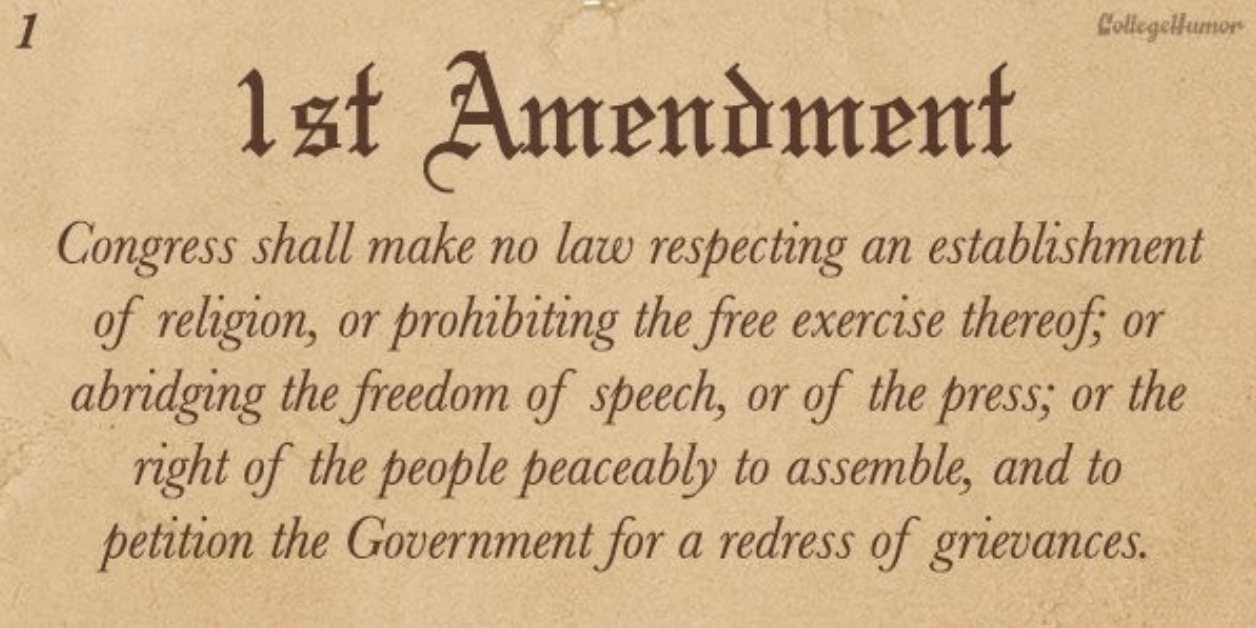
‘Congress shall make no law respecting an establishment of religion, or prohibiting the free exercise thereof; or abridging the freedom of speech, or of the press; or the right of the people peaceably to assemble, and to petition the Government for a redress of grievances.’
Instead of a simple parliamentary majority (51% of the vote), changing or repealing this clause would require a parliamentary supermajority (two thirds of the vote) and a nationwide referendum. This would be the approximate British equivalent to the system currently in place in the USA. This system requires one of either a two-thirds supermajority in both chambers of Congress, or two-thirds of states to call for a constitutional convention, alongside a ratification by 38 (three quarters) of US state legislatures - a nearly insurmountable barrier.
2. Redefining judicial power
Currently, under Article 4 of the Human Rights Act, British judges can issue a ‘Declaration of Incompatibility’ when they deem a law to infringe upon the right of free speech as guaranteed by Article 10. However, such a declaration can be (and often is) simply ignored by parliament. By contrast, if a US court finds that a law would suppress speech that is guaranteed by the First Amendment, they can declare it unconstitutional and effectively prohibit its enforcement, stripping it of any operative legal effect. They can do this by issuing injunctions, either against the plaintiffs in question or, occasionally, more broadly, to prevent the law from being enforced. Appellate and Supreme Court judges can create binding precedent that all lower courts must abide by.
In order for the UK to mirror the First Amendment’s power to trump new laws, UK judges would have to gain the power to dis-apply or invalidate acts of parliament. A more powerful version of the Supreme Court would have to replace it in its current form, whose rulings on speech would be final, nationwide, and universally binding (on lower courts, ministers, regulators, and parliament).
3. Replacing proportionality with categorical protection
Under the HRA and ECHR, free speech is a qualified right. This means it can legally be traded away for other ‘social goods’. Hence, when a British Court analyses whether a new law infringes upon the right of free speech as laid out in the HRA’s Article 10, they apply a four-stage inquiry (called the Quila test) to assess its ‘proportionality’ as measured against the ‘social goods’ it aims to promote:
Is the government pursuing a legitimate social aim (e.g., stopping ‘offensive’ protests to keep the peace)?
Is there a rational connection between this law and the social good it aims to bring about?
Is there a ‘pressing social need’ for this good in a democratic society?
Does the benefit to society outweigh the loss of the individual’s right?
Because terms such as ‘public order’ and ‘offence’ are inherently nebulous, the government almost always succeeds in winning the ‘fair balance’ argument.
Under the First Amendment framework, speech is prioritised over social goods in a principle called ‘strict scrutiny’. Often described as being ‘strict in theory, it fatal in fact’, it is a far more stringent standard that effectively precludes the institution of any law that may infringe on the freedom of speech.
Unlike the British system of ‘proportionality’ which requires only that the government needs a ‘legitimate aim’ (such as the defence of people against offence), US courts stipulate the need for a ‘compelling interest’ to uphold censorship laws. In practice, this sets the bar far higher than the UK, and can only be met in exceedingly rare circumstances (such a to prevent the imminent overthrow of government). ‘Offence’ and ‘discomfort’ are never compelling enough reasons on their own to pass this test.
US courts stipulate that a new law must be ‘narrowly tailored’, and the ‘least restrictive means’ of meeting its ‘compelling interest’. These criteria are restrictively applied to strike down laws that are deemed ‘overbroad’. For instance, if a law is necessary to stop terrorist recruitment but also happens to infringe upon access to history books about war, it violates the requirements as it fails to employ the least restrictive means possible to achieve its objective.
Hence, in order to have the same force as the First Amendment, British courts, in addition to having to take on the ability to invalidate parliamentary acts, must apply far more restrictive measures to judge which laws are justifiable under the framework of the nation’s new constitutional guarantee to free speech.
4. Abolishing content-based restrictions
The UK’s current regulation of ‘hate speech’ and ‘gross offences’ are content-based restrictions which involve the government judging an particular idea unacceptable. The First Amendment, as explained above, is most compelling in it restriction of exactly this.
Under new and more radical First Amendment-style protections, the only speech that could be criminalised would have to fall into the category of ‘incitement to imminent lawless action’. A famous example of such an action was described by US Supreme Court justice Justice Oliver Wendell Holmes Jr. as ‘shouting “fire” in a crowded theatre’.
In more granular terms, whereas the following statement would be protected under the First amendment:
‘I hate [X group of people] and hope they die’
Only a reformulation that constitutes ‘incitement to imminent lawless action’, such as the following statement, would be deepened illegal:
‘There is a member of [group X] right there; grab that brick and hit them now’.
5. Public Forum Doctrine
The UK government, under current laws, can ‘close’ or require ‘permits’ for gatherings and demonstrations that are often denied based on their expected level of disruption. Under a First Amendment blueprint, these areas would be considered constitutionally open by default, subject only to ‘time, place, and manner (TPM) restrictions’.
TPM restrictions are designed to regulate the logistics of speech, preventing gatherings that can become an excessive public nuisance (such as using megaphones at 3 AM). However, these would only be applied if they satisfy the conditions of:
Being applied equally to all gatherings, regardless of the thematic content of their speech.
Being warranted by significant government interest (e.g. allowing people to sleep or ambulances needing to pass through a critical road).
Allowing ample alternative channels. The government cannot, for instance, ban all protests. If protestors have to be moved off one street, they must be allowed to gather elsewhere in a way that allows them to continue to reach their intended audience.
Notably, this would also eliminate the ‘heckler’s veto’ from being enforced. This rule currently allows police to arrest speakers that threaten to upset the peace, such as a pro-Israel campaigner at a pro-Palestine rally.
How would such a protection actually be implemented in the UK?
Below are the two main means of making parliament subordinate to a near-absolute constitutional right to free speech:
Option 1: A written constitution enacted by a constituent assembly
Parliament passes an enabling act to dissolve its own supremacy
A separate constituent assembly is subsequently called to draft a constitution. This constitution will be supreme law, entrench speech categorically therein; grant courts strike down power, and enforce speech as a superior principle, not a value to be balanced against others.
This would be akin to the system in place in post-war Germany, South Africa, and Ireland (although Ireland requires referenda at the end), and be the ‘cleanest’, most legitimate option.
Option 2: Parliament legislated itself out of supremacy:
Parliament enacts a Constitution Act, which explicitly states that certain rights (such as speech) are supreme; that courts may dis-apply future inconsistent Acts; and that no implied repeal applies.
If courts accept this Act and agree to operate within its framework, it becomes legally foundational.
This takes advantage of the Diceyan loophole in British law, which holds that parliament can change their rules of recognition themselves. This is derived from the principle that parliamentary sovereignty exists because courts recognise it, and that court recognition of Parliament changing the basis of this sovereignty would amount to its legal entrenchment.
However, although past cases (R (Jackson) v Attorney General, Miller v Secretary of State for Exiting the EU) have hinted that such a move may be legitimate, courts retain an ability to openly revoke such an act and thereby preclude its validity. Furthermore, British legal tradition is ambiguous when it comes to whether a Constitutional Act could really be supreme over parliament.
This move, then would be highly controversial, although plausible.
Although there is no explicit legal requirement for a referendum to take place, it is customary to call one when major constitutional decisions are in question. The decision to leave the EU, much like the question of introducing sweeping reforms to our constitution and political system, was not a one that required a referendum. However, in practice, such momentous decisions demand a level of democratic mandate that only a direct appeal to the electorate can provide, effectively creating a constitutional convention that bypasses traditional parliamentary authority.
So,
Would the British public support First Amendment style speech protections?
Short answer: no.
Public opinion surveys suggest that Britons are generally content with their current level of free speech protections. In a 2025 representative survey, 44% of people in England and Wales felt freedom of speech has “about the right amount of protection” in Britain, compared to 33% who thought it is under-protected and 19% who thought it too protected. In other words, the majority of the British public value their access to freedom of speech and do not see a pressing need to enshrine greater protections.
Notably, a preponderance of Britons tend to prioritise protections against certain harms that may be induced by offensive speech over participation in a society with a right to completely unfettered speech. In the aforementioned 2025 survey, 59% of respondents said freedom from threats and abuse is under-protected, alongside another 41% who indicated that freedom from discrimination is under-protected. The study notes that this result serves to “highlight a potential tension between upholding free speech and ensuring the safety and equality of all individuals.” Based on this emphasis on equality, and the clear preference for protective measures against harmful speech, a motion to implement First Amendment-style system would be unlikely to garner enough support in a nationwide referendum.
A December 2021 YouGov survey revealed that this attitude extends to preventing hate speech at the expense of attenuating the scope of free speech guarantees. 43% of respondents indicated that they value ‘protecting people from offensive or hateful remarks over the right to free speech’. Further, the phrasing of this question, with ‘over’ used in place of ‘alongside’, may have deterred respondents from expressing their support for hate speech laws by explicitly framing them as binary alternative to freedom of speech. More concretely, a 2019 study found that 66% supported existing laws banning “stirring up hatred” on grounds like race, religion or sexual orientation (up from 63% in 2017), and 71% believed it should be illegal to use threatening, hateful language targeting people with disabilities. Such figures clearly indicate that British public opinion supports the criminalisation of extreme and hateful speech, a stance that is fundamentally irreconcilable with the First Amendment’s core requirement of viewpoint neutrality, which denies the government the authority to silence speech based on its moral or social offensiveness. This incompatibility would most likely preclude a wholesale importation, or perhaps even a partial adoption, of the U.S. model.
This broad support for laws that restrict the freedom of expression is mirrored in recent polls over the Online Safety Act. A 2023 poll, conducted as the Act was being debated in parliament, found that 71% of the public agreed that it is more important to ensure children are protected from harmful online content “even if some content is incorrectly censored for everyone,” rather than to ensure complete freedom of expression for all online. A strong majority likewise lent their support to restrictions such as age checks and content removal, with 80% supporting policies that would restrict access to websites hosting racist or hateful content.
This being said, the British public nevertheless endorses the principle of free speech in public and political discourse. A July 2024 Savanta poll of 2,000 UK adults found “eight in ten people” (77%) agreed that “politicians should be able to speak their minds and freely debate difficult issues.”. On the whole, the UK clearly retains a comparatively free press and a culture that countenances open debate. Perhaps this is why the majority of Britons have been so sanguine in the face of recent legislation, such as the Online Safety Act, and the lack of robust legal limits on government censorship, that has enabled the range of permissible expression in our nation to be cut back. There is a sense that this backsliding cannot possibly put the right of free speech into serious jeopardy.
Interestingly, although perhaps unsurprisingly, support for deeper speech protections is correlated to age group and political orientation (an orientation that is itself closely indexed to demographic variables, most notably gender.). Nearly half of over-65’s indicate that they believe young people are ‘too easily offended’ and lean towards a more absolutist stance over freedom of speech. Young people, on the other hand, are more favourably disposed towards values of inclusivity and sensitivity, which inform their more accepting positions towards limitations on harmful expression. In addition to older people, the 2025 survey showed that, men, white people, and Christians were far more inclined to say society is “too easily offended” (for example, 56% of men vs 44% of women; 54% of white Britons vs only 27% of ethnic minorities). These groups also more often felt free speech is under threat and should be given greater protection. By contrast, women, younger adults, ethnic minorities, and non-Christian religious individuals more frequently believed “people need to be more sensitive in how they speak” to avoid offending others.
It is unlikely, then, that public opinion would be able to provide the strong activation energy needed for parliament to even consider instituting a codified constitution, let alone produce the impetus needed for a near-absolutist right to free speech.